
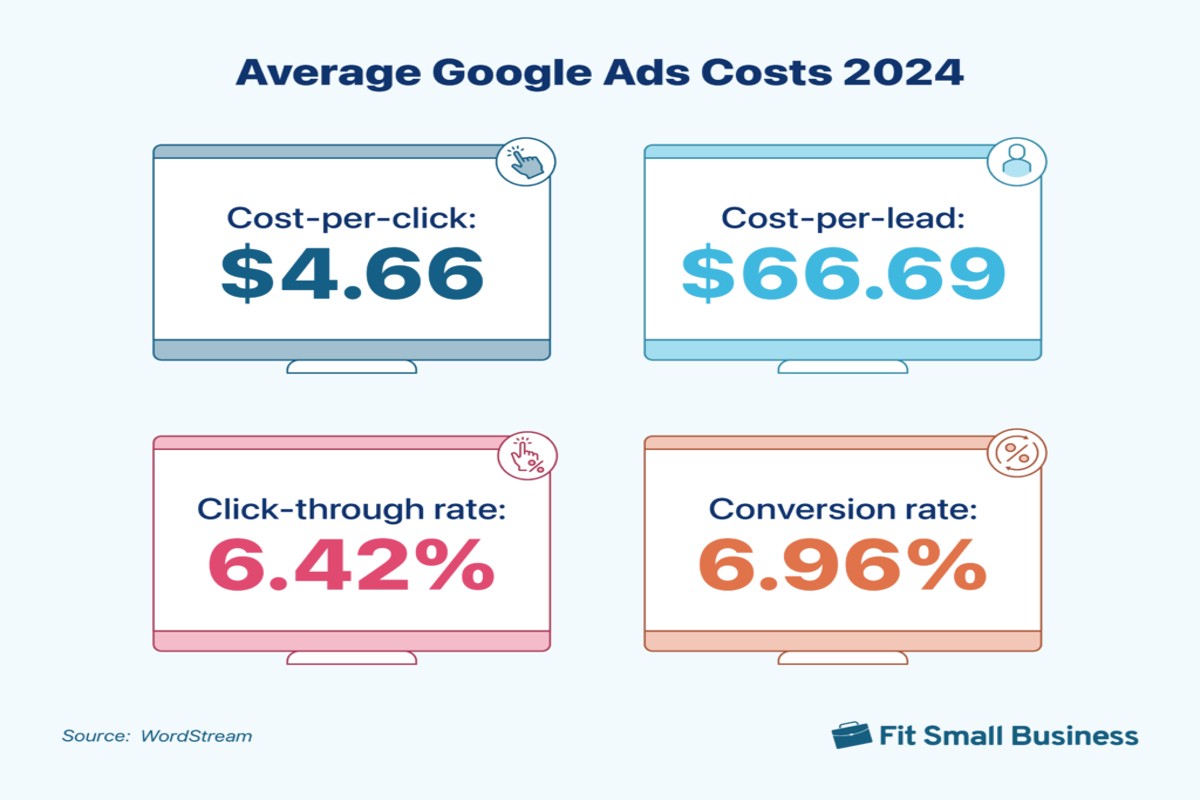
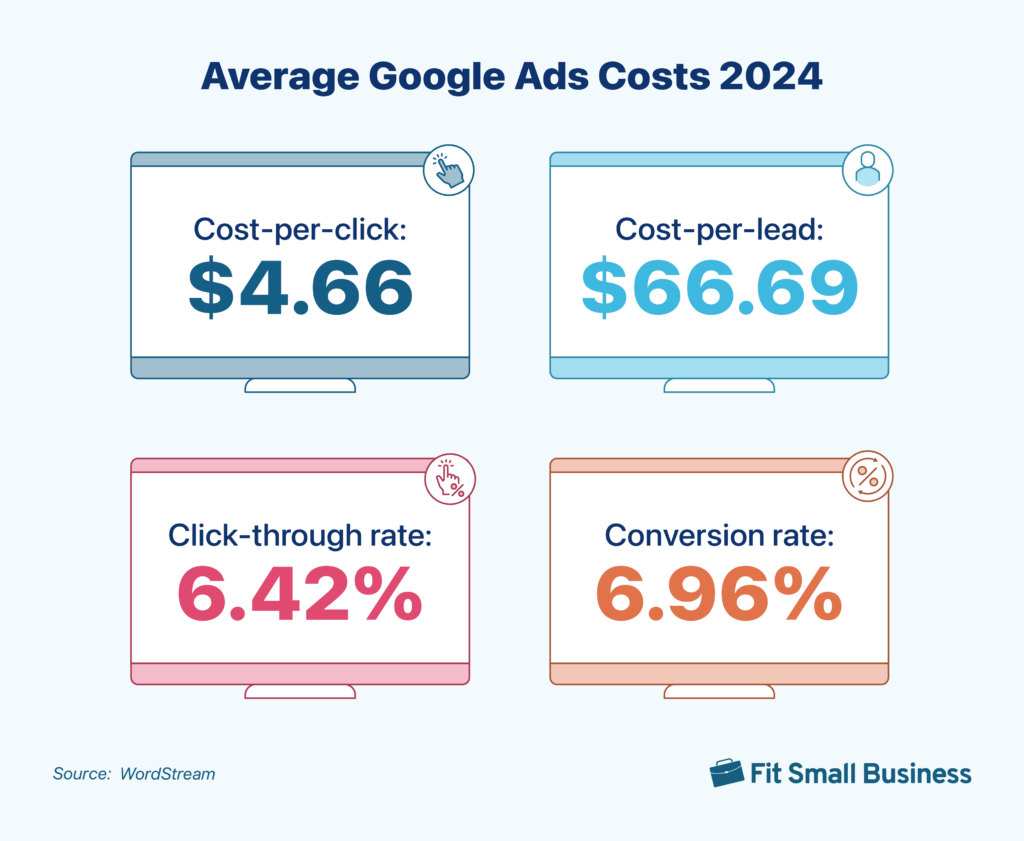
How much does it cost for Google Ads varies significantly based on industry, competition, and targeting options. On average, businesses can expect to pay between $1 to $2 per click for search ads, providing a scalable marketing solution that can yield high returns when managed effectively.
Understanding the cost of Google Ads is crucial for businesses aiming to enhance their online visibility and attract potential customers. With the global digital advertising market projected to reach $500 billion by 2023, knowing how to budget for Google Ads can significantly impact a company’s marketing strategy and overall profitability.
Failure to accurately assess google ads costs can lead to overspending, ineffective campaigns, and lost revenue opportunities. Businesses that miscalculate their advertising budget risk falling behind competitors who effectively leverage their marketing investments.
This article will provide a detailed breakdown of Google Ads costs, including comparisons of top providers, a comprehensive cost analysis, best practices for maximizing ad spend, and insights into leveraging local SEO strategies to enhance campaign effectiveness.
What factors influence the cost of Google Ads?
The cost of Google Ads can vary significantly, typically ranging from $1 to $2 per click for the average advertiser. However, costs can skyrocket based on several key factors. In competitive industries, for instance, costs can exceed $50 per click. Understanding these factors is essential for effective budgeting.
Several elements influence the overall cost of Google Ads, impacting both pricing and campaign efficiency:
- Competition: The level of competition in your industry directly impacts costs. High-demand keywords often lead to higher bids — multiple advertisers are vying for the same audience.
- Industry: Certain sectors, like legal services or finance, have higher average costs per click (CPC) due to their lucrative nature. Here, CPCs often exceed $20 (this is often overlooked).
- Targeting Options: The more specific your targeting (e.g., demographic, geographic, or behavioral), the higher the costs may be. Narrow targeting can yield higher CPCs but often improves conversion rates.
- Quality Score: Google assigns a Quality Score based on ad relevance, landing page quality, and expected click-through rate. A higher Quality Score usually means lower costs, as it indicates a better user experience.
- Ad Placement: The position of your ads on the search results page affects costs. Ads that appear at the top typically require a higher bid compared to those positioned on the side or at the bottom.
Budget management is crucial. Advertisers should continuously monitor performance metrics and adjust their strategies to optimize spending. Regularly reviewing keywords, ad copy, and targeting settings makes campaigns more cost-effective.
Expert insight: Use tools like Google Ads Keyword Planner to assess keyword competition and estimated costs before launching campaigns. This helps in setting realistic budgets — and expectations.
How do I set a budget for Google Ads?
To set a budget for Google Ads, first define your business goals, analyze your expected return on investment (ROI), and consider industry benchmarks. Businesses typically allocate between $1,000 to $10,000 per month — this varies by advertising objectives and market competition.
Begin by identifying your primary goals for the campaign. Are you aiming for brand awareness, lead generation, or direct sales? Each objective often calls for a different budget allocation. For instance, lead generation could require a higher budget to ensure adequate ad exposure and click-through rates.
Next, analyze your expected ROI. Calculate how much revenue a new customer generates. Then, determine how much you’d spend to acquire that customer. A common guideline is to spend no more than 10% of your projected revenue from a new customer on advertising. This approach helps maintain profitability while maximizing ad effectiveness.
Lastly, research industry benchmarks for cost-per-click (CPC) and average conversion rates. These metrics can guide your budget decisions. For example, if your industry has an average CPC of $2 and a conversion rate of 5%, a budget of $1,000 might yield around 500 clicks, which could result in 25 conversions — assuming the average customer value supports the ad spend.
Expert insight: Regularly review and adjust your budget based on campaign performance data. Make sure to use Google Ads’ reporting tools to track ROI and optimize your spending for the best results over time (this is often overlooked).
What is the average cost per click for Google Ads?
The average cost per click (CPC) for Google Ads generally falls between $1 and $2 across different industries. Yet, in highly competitive sectors, CPC can shoot up — sometimes exceeding $50 for certain keywords. This variation mainly stems from industry competition and targeting strategies.
Several factors impact the cost of Google Ads, especially CPC. These include:
- Industry Competition: Industries like finance, legal services, and insurance frequently face higher CPC due to intense competition for limited keywords. Legal keywords, for instance, can hit CPCs over $100 (this is often overlooked).
- Quality Score: Google gives each ad a Quality Score based on relevance, landing page experience, and expected click-through rate. A higher Quality Score can lower CPC — Google tends to reward advertisers with relevant ads.
- Targeting Options: Geographical targeting, audience demographics, and specific keyword targeting all affect CPC. More refined targeting can lead to higher costs. This happens due to increased competition for niche audiences.
CPC can also vary with seasonal trends and economic factors. For example, retail sectors often see higher CPC during holiday seasons when competition for consumer attention ramps up. Advertisers need to regularly review and optimize their campaigns to maintain a favorable CPC.
Expert insight: To manage costs effectively, focus on boosting your Quality Score. Consider using long-tail keywords, which tend to have lower competition. They can yield higher conversion rates at a reduced CPC.
How can I reduce my Google Ads costs?
To reduce Google Ads costs, implement strategies that boost campaign efficiency while maximizing reach. Businesses can lower their costs by optimizing ad targeting and improving ad quality scores. Effective management can often lead to cuts of 20% or more in overall ad spend.
One key strategy to cut costs is to focus on keyword selection. Conduct thorough keyword research. Identify high-performing, low-competition keywords that deliver relevant traffic at a lower cost. Use tools like Google Keyword Planner to find keywords with a high click-through rate (CTR) and low cost-per-click (CPC). Additionally, consider long-tail keywords — these often have less competition and can be more cost-effective.
- Optimize Ad Quality Score: Google rewards ads with higher relevance and quality. Improve your ad copy, landing pages, and targeting to boost your Quality Score, which can lower your CPC.
- Use Negative Keywords: Implement negative keywords to avoid showing ads for irrelevant searches (this is often overlooked). This helps reduce wasted ad spend and improves overall campaign performance.
- Adjust Bidding Strategies: Experiment with various bidding strategies, like manual CPC or target CPA, to find the most cost-effective approach for your specific goals.
- Schedule Ads Wisely: Analyze performance data to figure out optimal times for ad visibility. Run ads during peak times to maximize impressions — and minimize costs during low-performance periods.
Expert insight: Regularly review and adjust your campaigns based on performance analytics. Continuous optimization based on data-driven decisions is essential for maintaining a low-cost, high-return Google Ads strategy (worth double-checking).
Is google ads worth the investment?
Yes, Google Ads can be a worthwhile investment if managed effectively — often yielding a return on investment (ROI) that can exceed 200%. Businesses that invest in Google Ads typically see average conversion rates of around 4.4% on search ads, compared to just 0.57% for display ads.
The value of Google Ads largely hinges on a business’s understanding of its target audience and how well it manages its campaigns. Companies that conduct thorough keyword research and craft highly relevant ads usually achieve higher click-through rates (CTR) and lower costs per acquisition (CPA). Interestingly, industries like legal services or high-end retail—known for high customer lifetime values—may find Google Ads especially beneficial. The initial costs can be offset by significant long-term gains (this is often overlooked).
Another critical factor that affects the effectiveness of Google Ads is competition within the chosen market. In sectors that are highly competitive, the cost per click (CPC) can be substantial. However, this competition often indicates a lucrative market — meaning that spending more on ads might lead to greater returns. Businesses should also keep seasonality and trends in mind; certain times of the year can yield higher conversion rates. Strategic ad spending during these periods can be more advantageous.
Expert insight: To maximize ROI from Google Ads, continuously optimize campaigns based on performance data and use remarketing strategies to re-engage potential customers. This approach can significantly enhance conversion rates and ensure that advertising dollars are spent efficiently.
Understanding Google Ads Auction and Bidding
This section explores the Google Ads auction process, explaining how bids and Quality Score impact advertising costs. Grasping this mechanism is crucial for optimizing ad spend and maximizing return on investment.
Overview of the Google Ads Auction Process
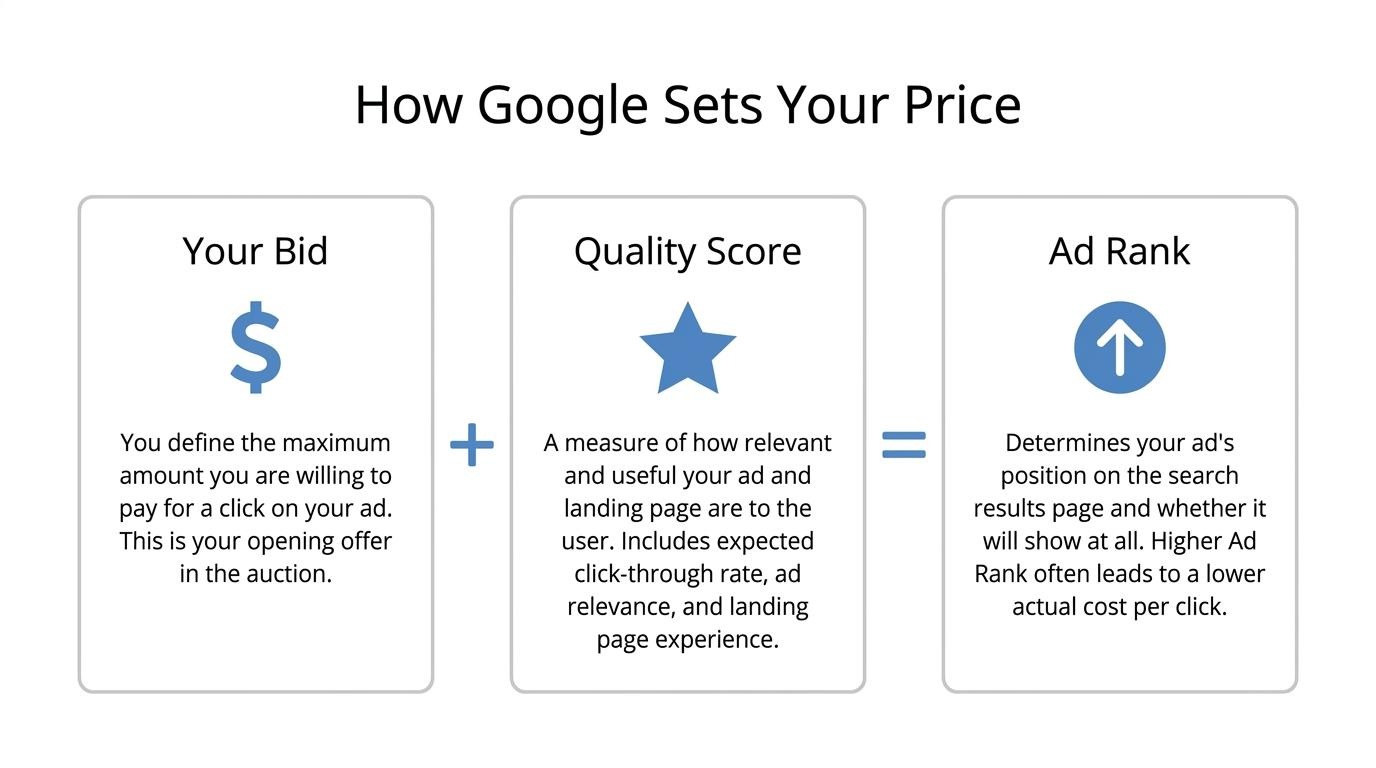
The Google Ads auction operates as a dynamic system that decides which ads show up on search results pages and their placements. Advertisers submit bids for keywords relevant to their products or services. When a user conducts a search, Google evaluates the bids and selects ads based on two main factors: the bid amount and the Quality Score.
This auction takes place in real-time — meaning costs can vary according to competition for specific keywords. Advertisers can establish a daily budget, but actual costs per click (CPC) depend on auction results, which take multiple aspects into account.
How Quality Score Influences Ad Costs
Quality Score serves as a key metric for Google, assessing the relevance of ads, keywords, and landing pages. It ranges from 1 to 10, with higher scores indicating better quality. A higher Quality Score often leads to reduced costs, as it lowers the bid required for a desired ad position.
Key elements affecting Quality Score include:
- Ad Relevance: How closely the ad matches the user’s search query.
- Expected Click-Through Rate (CTR): The probability that users will click on the ad.
- Landing Page Experience: The quality and relevance of the landing page linked to the ad.
Recent data indicates that advertisers with a Quality Score of 8 or above can expect to pay up to 30% less per click compared to those with lower scores.
Types of Bidding Strategies Available
Google Ads provides several bidding strategies tailored to various advertising objectives. These include:
- Manual CPC: Advertisers manually set their maximum CPC bids.
- Enhanced CPC: Google automatically adjusts bids for optimal conversions while adhering to a set budget.
- Target CPA: Focusing on a specific cost per acquisition, Google optimizes bids to reach this target.
- Maximize Conversions: Automatically sets bids to achieve the highest number of conversions within the budget.
- Target ROAS: Concentrates on achieving a specific return on ad spend.
Choosing the right bidding strategy is vital for controlling costs and aligning with business goals.
Impact of Ad Rank on Visibility and Cost
Ad Rank determines an ad’s position on the search results page and is calculated using the bid amount and Quality Score. A higher Ad Rank leads to better visibility, often resulting in increased click-through rates and conversions.
The formula for calculating Ad Rank is:
Ad Rank = Bid Amount x Quality Score
Advertisers with a higher Ad Rank might pay less per click than competitors with lower ranks, even if their bids are higher. Thus, effectively managing both bids and Quality Score is crucial for maximizing ad performance while minimizing costs.
Nuance / Expert Layer
Common misconceptions about Google Ads often stem from the belief that higher bids automatically guarantee better ad placements. While bid amount plays a role, it’s the combination of bid and Quality Score that truly determines Ad Rank. A well-optimized campaign with a lower bid can outperform competitors with higher bids if it maintains a superior Quality Score. Additionally, some advertisers overlook the importance of continuous testing and optimization (this is often overlooked), which can provide significant cost savings and enhanced ad performance over time.
Practical Application
To effectively utilize insights from the Google Ads auction system, advertisers should:
- Continuously monitor and enhance Quality Score components.
- Select a bidding strategy that aligns with specific campaign goals.
- Regularly test and tweak bids to find the optimal CPC for desired ad placements.
- Analyze competitor bidding strategies to uncover opportunities for cost savings.
By implementing these strategies, advertisers can manage their budgets efficiently and enhance the performance of their Google Ads campaigns. This ultimately answers the question: how much does it cost for Google Ads?
Industry-Specific Cost Analysis
This section examines how Google Ads costs vary across different industries, offering businesses vital insights into what to expect in terms of expenses based on their specific sector. Recognizing these differences is essential for effective budgeting and campaign planning.
Comparison of CPC Across Various Industries
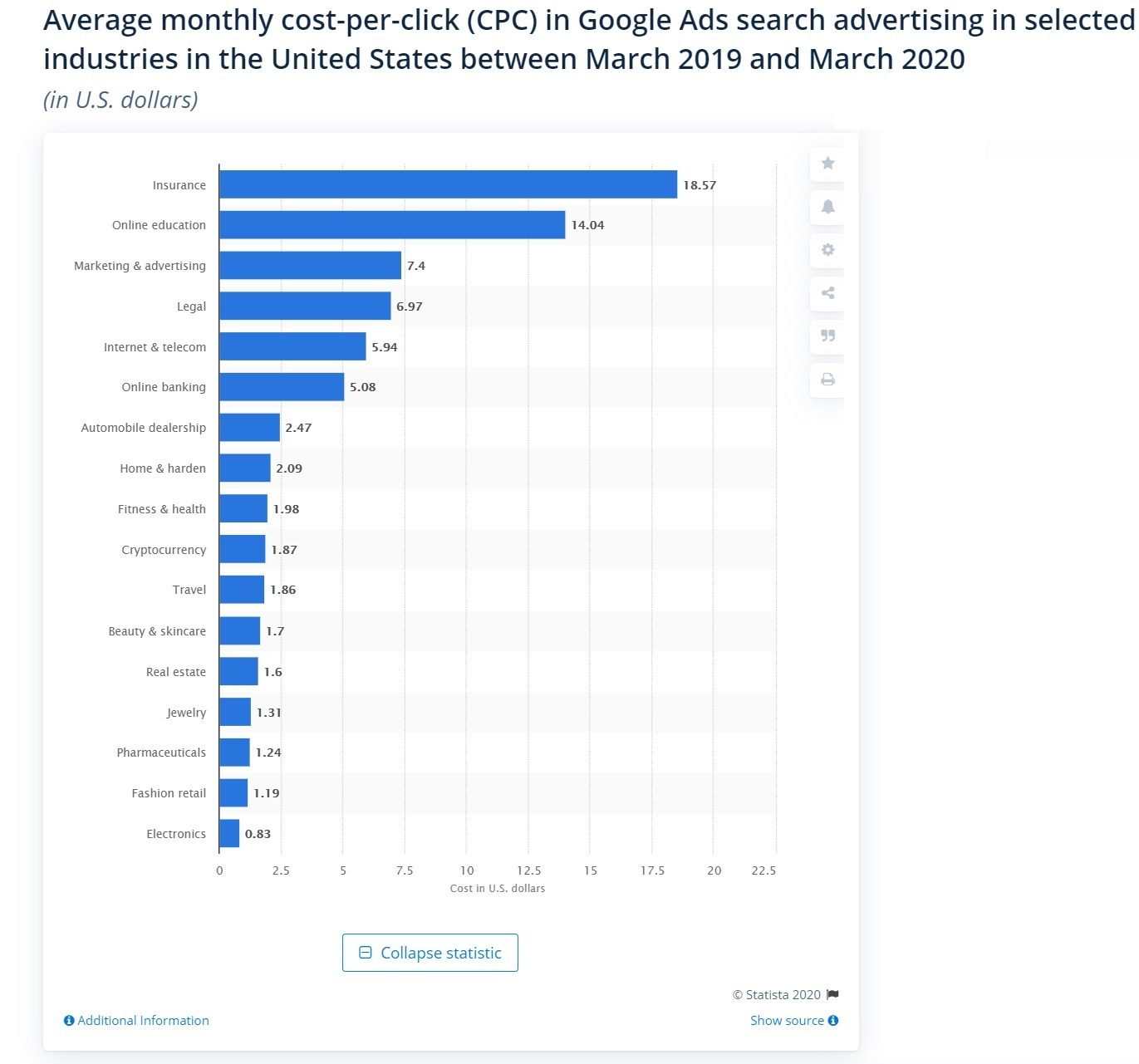
Cost-per-click (CPC) rates for Google Ads can fluctuate significantly between industries. As of 2024, the average CPC across all sectors sits at about $2.69. But this average masks considerable variations:
- Legal Services: Average CPC can hit $6.75, largely due to fierce competition and the high stakes of client acquisition.
- Finance and Insurance: CPC is around $5.60, reflecting the worth of leads in this field.
- Health Services: CPC typically hovers near $3.95, driven by the necessity for targeted outreach and patient acquisition.
- Retail: Average CPC rests at about $1.10, benefiting from wider audience engagement and lower competition.
Factors Contributing to Higher Costs in Competitive Sectors
Several factors contribute to heightened advertising costs in competitive industries:
- Competition Level: Sectors like legal and finance face intense competition, pushing up CPC as multiple advertisers compete for the same keywords.
- Customer Lifetime Value (CLV): Industries with high CLV, such as insurance, warrant higher ad spending to attract valuable customers.
- Keyword Demand: The demand for specific keywords can inflate costs, especially in crowded markets.
Case Studies of Successful Ad Campaigns
Successful Google Ads campaigns demonstrate the potency of targeted approaches across various industries:
- Legal Firm ABC: Secured a 300% ROI by emphasizing long-tail keywords, which helped lower CPC while boosting conversion rates.
- Insurance Company XYZ: Employed remarketing strategies to cut costs by 40%, effectively re-engaging previous visitors at a reduced CPC.
- Health Service Provider 123: Used local targeting to drive foot traffic, achieving a 150% surge in bookings at a modest CPC of $2.50.
Tips for Businesses in High-Cost Industries
Businesses in high-cost sectors can refine their Google Ads strategies by following these recommendations:
- Use Long-Tail Keywords: These keywords generally face less competition and can lead to higher conversion rates.
- Focus on Quality Score: Improve ad relevance and landing page quality to lower CPC.
- Implement Geographic Targeting: Concentrate on specific regions to maximize the efficiency of ad spending.
There’s a common misconception that high CPC equals poor ad performance; however, many businesses find substantial ROI despite higher costs. The trick is in optimizing ad relevance, targeting, and the overall marketing strategy.
To keep advertising costs in check, businesses should perform regular keyword research, tweak bidding strategies based on performance metrics, and continuously test ad creatives. Establishing a solid understanding of industry benchmarks will facilitate informed decision-making and effective budget allocations.
Maximizing Your Google Ads Budget
This section outlines advanced strategies aimed at improving the effectiveness of Google Ads spending. The goal is a higher return on investment (ROI) and less wasted expenditure.
Identifying High-Performing Keywords
Effective keyword research forms the backbone of a successful Google Ads campaign. Focus on pinpointing high-performing keywords that align with your business goals. Use tools like Google Keyword Planner to assess search volume, competition, and suggested bids. Prioritize keywords that offer a blend of high traffic and manageable competition.
- Look for keywords with a click-through rate (CTR) above 3%.
- Consider long-tail keywords. They often come with less competition and higher conversion rates.
- Regularly review and update your keyword list based on performance metrics.
Utilizing Negative Keywords to Reduce Waste
Incorporating negative keywords into campaigns can significantly boost efficiency. Negative keywords keep your ads from appearing for irrelevant search queries — thus reducing wasted clicks and costs.
- Identify common search terms that might attract the wrong audience.
- Regularly update your negative keyword list based on ongoing performance data.
- Use Google’s Search Terms report to discover potential negative keywords (this is often overlooked).
A/B Testing Ad Copy and Landing Pages
A/B testing serves as a critical strategy for optimizing ad performance. By comparing different versions of ad copy and landing pages, businesses can spot the most effective elements that drive conversions. This process matters.
- Test various headlines, descriptions, and call-to-action phrases.
- Experiment with different landing page designs to see which layout yields the highest conversion rate.
- Track performance metrics, such as CTR and conversion rates, to make data-driven decisions.
Leveraging Remarketing Strategies for Better ROI
Remarketing effectively re-engages users who’ve previously interacted with your site. This strategy can significantly increase conversions by reminding potential customers of your products or services.
- Create segmented lists based on user behavior, such as site visitors or cart abandoners.
- Use tailored ads that directly address the interests of these segments.
- Consider raising bids for remarketing audiences — they’re more likely to convert.
In 2024, businesses implementing effective remarketing strategies can see up to a 400% increase in conversion rates when compared to standard display ads.
Many advertisers underestimate the necessity of ongoing optimization in Google Ads. A common misconception is that once a campaign launches, it no longer needs adjustments. In reality, continuous analysis and refinement are vital for adapting to changing market conditions and audience behavior. Furthermore, focusing solely on high-volume keywords without considering long-tail variations can often lead to missed conversion opportunities.
To maximize a Google Ads budget, start with thorough keyword research and a solid negative keyword strategy. Regularly A/B test ad copy and landing pages to identify the most effective combinations. Finally, leverage remarketing to re-engage potential customers. Maintain a habit of consistent monitoring and optimization to keep campaigns aligned with market trends and user preferences.
Common Mistakes That Increase Google Ads Costs
This section highlights frequent errors that can inflate Google Ads expenses and offers strategies to counter these issues. Avoiding these mistakes is crucial for maximizing return on investment (ROI) and managing ad spend effectively.

Overlooking Keyword Research
Effective keyword research is the backbone of any successful Google Ads campaign. Neglecting this step can lead to targeting irrelevant keywords — which usually results in wasted ad spend. The average cost-per-click (CPC) for highly competitive keywords in 2024 is projected to be around $2.50. In contrast, less competitive keywords can cost as little as $0.50. Investing time in thorough keyword analysis helps advertisers concentrate on terms that drive conversions, minimizing unnecessary costs (this is often overlooked).
Failing to Optimize Landing Pages
Landing pages play a critical role in turning clicks into customers. If these pages aren’t optimized for user experience, bounce rates might rise. This leads to wasted clicks and higher costs. Recent studies show that optimized landing pages can improve conversion rates by over 40%. Key elements include fast loading times, clear calls to action, and mobile responsiveness — all crucial for enhancing performance and cutting overall costs.
Ignoring Ad Performance Metrics
Continuous monitoring of ad performance metrics is essential for effective budget management. Failing to analyze data like click-through rates (CTR) and conversion rates can lead to ongoing spending on underperforming ads. A low CTR, for instance, can indicate that an ad isn’t resonating with its audience — adjustments to the ad copy or targeting parameters are often necessary. Regularly reviewing these metrics ensures that campaigns are optimized and costs are kept in check.
Not Adjusting Bids Based on Performance Data
Static bidding strategies often lead to overspending on less effective ads. Adjusting bids based on performance data allows advertisers to use their budget more efficiently. For example, increasing bids on high-performing keywords can enhance visibility — while lowering bids on underperformers helps reduce costs. Utilizing automated bid strategies, such as Target CPA (Cost Per Acquisition), can also optimize spending based on real-time performance metrics.
Nuances and Common Misconceptions
Many advertisers mistakenly think that higher bids automatically guarantee better ad placements. While bid amounts are certainly a factor, Google’s Quality Score plays a significant role too. This score assesses the relevance and quality of ads, keywords, and landing pages. A well-structured campaign with relevant keywords and optimized landing pages can achieve superior placements at lower costs. It’s a common myth that spending more is always better. Understanding this dynamic is crucial for effective budget management.
Practical Application
- Conduct comprehensive keyword research using tools like Google Keyword Planner before launching campaigns.
- Make sure landing pages are optimized for user experience and aligned with ad messaging.
- Regularly review and analyze ad performance metrics to make informed adjustments.
- Use automated bidding strategies to optimize ad spend based on real-time performance data.
Addressing these common mistakes allows advertisers to significantly reduce costs related to Google Ads and improve overall campaign performance. Implementing these strategies leads to a more efficient budget and enhanced ROI.
Frequently Asked Questions
What factors influence the cost of Google Ads?
The cost of Google Ads is influenced by factors such as competition for keywords, ad quality, and targeting options. Higher competition and lower quality scores can lead to increased costs.
How do I set a budget for Google Ads?
To set a budget for Google Ads, determine your overall advertising goals and allocate funds accordingly. Google Ads allows you to set daily or monthly budgets to control spending.
What is the average cost per click for Google Ads?
The average cost per click (CPC) for Google Ads varies widely by industry, typically ranging from $1 to $2 on the search network. Competitive industries may see higher CPCs.
How can I reduce my Google Ads costs?
To reduce Google Ads costs, focus on improving ad quality, optimizing targeting options, and using negative keywords. Regularly reviewing and adjusting campaigns can also help lower expenses.
Is Google Ads worth the investment?
Google Ads can be worth the investment for businesses seeking immediate visibility and traffic. The effectiveness largely depends on campaign management and alignment with business goals.
Final Thoughts on how much does it cost for google ads
The cost of Google Ads is inherently variable, shaped by factors such as industry competition, keyword selection, and bidding strategies, making a one-size-fits-all approach ineffective. However, businesses that strategically analyze these elements and implement tailored budgeting and optimization techniques can significantly enhance their return on investment.
To effectively manage your Google Ads budget, conduct a thorough competitive analysis to identify cost-effective keywords and refine your bidding strategy based on performance data, ensuring that every dollar spent aligns with your overall marketing objectives.
Ready to optimize your campaigns? Consult a google ads expert today and start maximizing your advertising budget!
Understanding the nuances of Google Ads costs is essential for any business aiming to thrive in a digital-first landscape, as it directly impacts visibility, lead generation, and ultimately, revenue growth.