

How to get clients for a property management company involves strategies aimed at attracting and retaining clients through effective marketing and networking. A strong online presence, active social media engagement, and community networking are essential, as studies indicate that 70% of property management companies acquire clients through referrals and online marketing.
Understanding how to get clients for a property management company is critical for business growth and sustainability. Property management professionals must navigate a competitive landscape where effective client acquisition strategies can significantly impact profitability. The property management market is expected to grow to over $22 billion by 2025, making effective client acquisition strategies essential for capitalizing on this expansion.
Failure to grasp effective client acquisition techniques can lead to missed revenue opportunities and wasted marketing resources, placing property management companies at a competitive disadvantage. Without a strategic approach, businesses risk stagnation in a rapidly evolving market.
This article will explore proven methods for acquiring clients, including a comparison of top marketing strategies, cost breakdowns for various acquisition channels, best practices for leveraging local SEO, and the importance of building a referral network.
What are the best marketing strategies for property management companies?
Effective marketing strategies for property management companies combine digital marketing techniques with strong networking efforts. A 2024 survey revealed that 70% of property management firms identified online marketing as their main source of new clients. This trend underscores the importance of adapting to digital landscapes.
Digital marketing is crucial for property management companies aiming to attract clients in a competitive environment. A strong online presence enhances visibility and boosts credibility. Key strategies include:
- Search Engine Optimization (SEO): Optimize your website using relevant keywords like “property management” and localized terms. This improves organic search rankings and increases the chances of attracting potential clients actively looking for services.
- Social Media Marketing: Engage with property owners and tenants on platforms like Facebook, Instagram, and LinkedIn. Sharing valuable content, property listings, and client testimonials helps build trust and draw interest.
- Email Marketing: Create targeted email campaigns to nurture leads and maintain relationships with existing clients. Regular updates on services, industry news, and property management tips keep your audience engaged (this is often overlooked).
- Online Reviews and Reputation Management: Encourage satisfied clients to leave positive reviews on platforms such as Google and Yelp. A high rating can significantly sway potential clients’ decisions — it’s an important factor.
- Content Marketing: Develop informative blog posts, videos, and guides related to property management. This strategy positions the company as an industry expert and draws clients through valuable resources.
Networking remains essential for client acquisition in property management. Building relationships with real estate agents, local businesses, and community organizations can lead to referrals. Attend industry events, join local business groups, and participate in community activities to expand your network.
Expert insight: Focus on creating a referral program that incentivizes current clients to recommend your services. This can lead to a steady stream of new clients. After all, word-of-mouth remains one of the most effective marketing strategies in the property management sector.
How can I network effectively to find clients in property management?
Networking effectively for a property management company is about building relationships, especially through local events and professional organizations. Engaging with real estate associations can lead to valuable connections — and potential clients. About 70% of new business comes from referrals and networking activities, which is significant.
To get started, attend local real estate events like property expos and home improvement fairs. These venues provide a chance to meet property owners and real estate investors who may need management services. Don’t forget to bring business cards. Be ready to discuss your services succinctly. Additionally, consider hosting or sponsoring a local event to boost visibility — and establish credibility in the community.
- Join local and national real estate associations, such as the National Association of Residential Property Managers (NARPM) or the Institute of Real Estate Management (IREM). Membership often brings access to networking events and educational resources.
- Participate in community activities and business networking groups like the Chamber of Commerce. These platforms let you connect with local business owners and residents who might need property management services.
- Use social media platforms like LinkedIn to connect with real estate professionals. Regularly post relevant content and engage with others in the industry — this enhances your online presence.
- Attend seminars, workshops, and webinars focused on property management and real estate investing. These events often provide insights into industry trends and help you meet potential clients.
- Follow up with contacts made during networking events. A simple email or phone call can reinforce the connection and keep you top-of-mind when they need property management services.
Expert insight: Leverage technology by using CRM software to track your networking efforts and follow-ups. This ensures that no lead is overlooked (this is often overlooked) and helps maintain relationships with potential clients over time.
What online platforms are best for attracting property management clients?
Attracting clients for a property management company involves using effective online platforms like social media, Google Ads, and real estate websites. Each platform has its own advantages tailored to various client engagement and marketing strategies.
Social media platforms such as Facebook, Instagram, and LinkedIn are excellent for building brand awareness and connecting with prospective clients. Facebook’s targeted advertising based on demographics and interests makes it simpler to reach potential property owners. Instagram’s focus on visuals is great for showcasing properties and engaging a younger audience. Meanwhile, LinkedIn can be instrumental for professional networking — it helps establish credibility in the industry.
Google Ads offers a powerful platform for reaching potential clients who are actively searching for property management services. With pay-per-click (PPC) capabilities, businesses can target specific keywords related to property management. This ensures visibility when potential clients perform relevant searches. According to recent data, businesses using Google Ads often see an average return on investment of about 200%, which highlights its effectiveness.
Real estate websites like Zillow, Realtor.com, and local MLS sites also play a crucial role in attracting clients. These platforms are commonly visited by property owners looking to list their homes or find management services. By optimizing listings and confirming a strong presence on these sites, property management companies can capture leads directly from individuals who are actively seeking help.
- Social Media: Focuses on engagement and brand awareness.
- Google Ads: Targets active searchers, providing high ROI through PPC campaigns.
- Real Estate Websites: Directly captures leads from property owners visiting popular listing sites.
Expert insight: For maximum effectiveness, integrate these platforms into a cohesive marketing strategy. Make sure to track performance metrics across all channels. This helps identify which platforms yield the best results in client acquisition.
How much should I budget for marketing my property management company?
Budgeting for marketing a property management company usually falls between 5% to 10% of projected annual revenue. For a company that anticipates $100,000 in revenue, this means a marketing budget of $5,000 to $10,000 annually.
Several factors shape the marketing budget for a property management company. These include the target market, the range of services provided, and the competitive landscape. Each factor can considerably affect the overall costs.
- Target Market: The demographics and geographic area of potential clients can influence marketing strategies. Urban areas often require a heftier investment in digital marketing and local advertising.
- Service Scope: Companies that provide specialized services — such as luxury property management or multi-family units — may find it necessary to set aside more funds for targeted marketing efforts.
- Competitive Landscape: Highly competitive areas typically demand a larger marketing budget to stand out. Companies often need to invest in unique selling propositions and effective branding efforts.
Additionally, the selection of marketing channels impacts costs. Digital marketing, which includes social media and search engine optimization, generally requires continuous investment. Traditional methods, like print advertising or local sponsorships, can vary in costs based on their reach and frequency (this is often overlooked).
Expert insight: Set aside a portion of your budget for experimenting with new marketing strategies. This enables adaptation based on what resonates with your target audience — and maximizes return on investment.
How long does it take to get clients for a property management company?
On average, acquiring clients for a property management company takes about three to six months. Yet, this timeframe can differ greatly based on a few key factors, such as market conditions, marketing strategies, and networking efforts.
Several factors influence how long it takes to gain clients. First, the local real estate market is crucial. In competitive markets with high demand for rental properties, property management companies might find clients quicker. On the flip side, in slower markets, the timeline often stretches as landlords hesitate to hire outside management services.
Another significant factor is how effective the marketing strategies are. Companies that use a mix of online marketing, networking, and referrals typically see faster client acquisition. Building a robust online presence — including a well-optimized website and active social media — can draw in potential clients. Plus, establishing relationships with real estate agents can lead to referrals, thereby speeding up the process.
Finally, a company’s reputation and experience also affect how quickly clients are acquired. Established businesses with a solid track record tend to attract clients faster than newer ones. Testimonials, case studies, and positive online reviews build trust—these elements encourage potential clients to engage services sooner.
Expert insight: To accelerate client acquisition, invest in targeted marketing campaigns that highlight your unique services and benefits. Actively engage with local real estate professionals for potential partnerships (this is often overlooked).
What are common mistakes to avoid when trying to get clients?
Common mistakes in client acquisition for property management companies include neglecting online presence, failing to differentiate services, and inadequate follow-up. Research shows that 70% of potential clients will choose a company based on its online reputation and visibility.
One prevalent pitfall is underestimating the importance of a strong online presence. For instance, a property management firm might invest heavily in traditional marketing methods — like flyers and local ads — but overlook the need to optimize its website or engage on social media. As a result, they miss out on many leads. Studies indicate that 81% of buyers conduct online research before making a decision. To avoid this, companies should make sure their website is user-friendly, informative, and optimized for search engines. Active engagement on social media can also help build brand awareness and trust (this is often overlooked).
Another common mistake is failing to articulate unique selling points clearly. A property management company may offer similar services as competitors but doesn’t highlight what sets it apart. This might include superior customer service or specialized expertise in a particular market segment. For example, if a company specializes in managing luxury properties, it should emphasize this niche in its marketing materials. This differentiation can greatly enhance appeal to potential clients and improve conversion rates.
Expert insight: Regularly soliciting feedback from current clients can identify areas for improvement in service offerings and marketing strategies. Ultimately, this enhances client acquisition efforts.
Building an Effective Online Presence
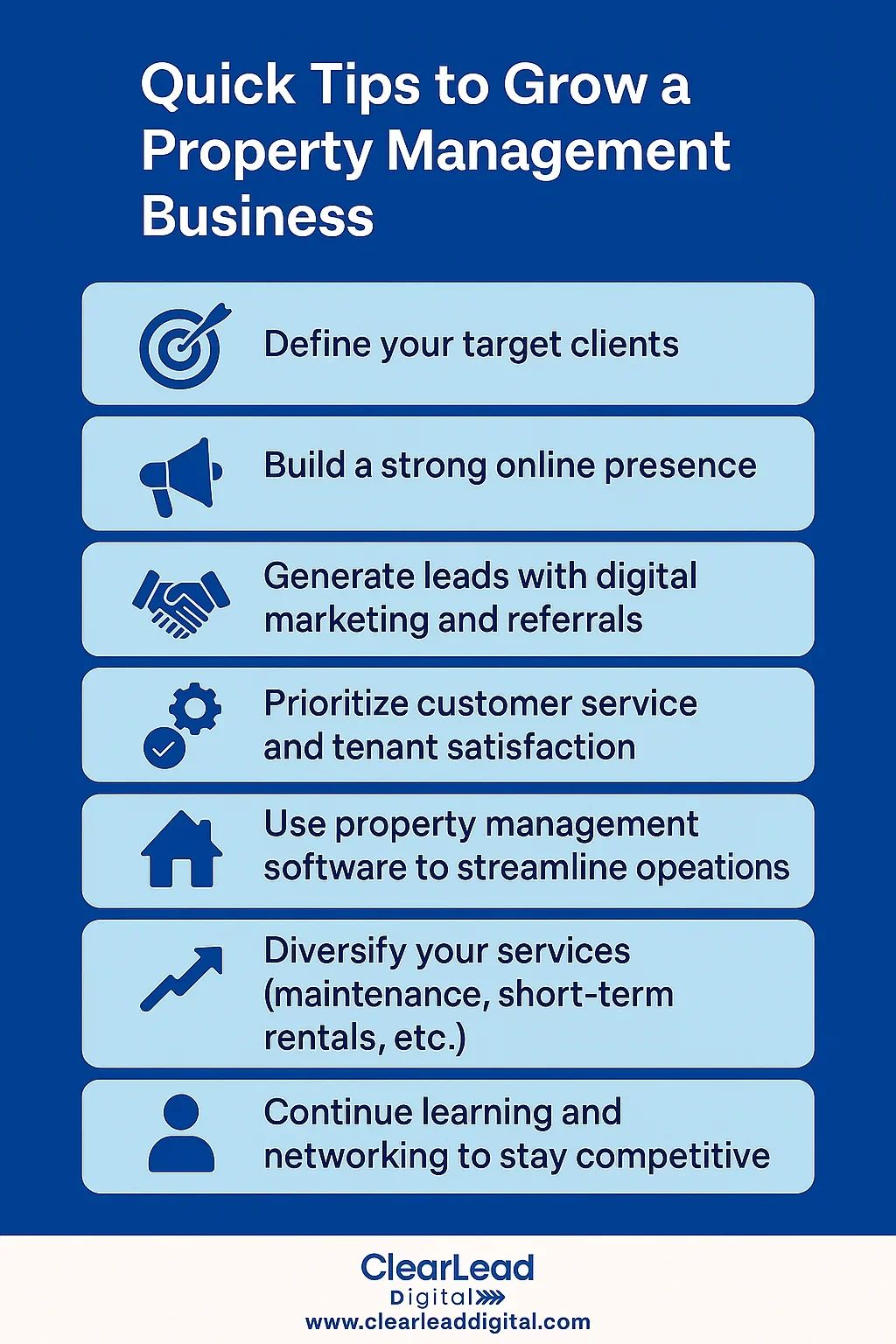
An effective online presence is crucial for property management companies aiming to attract new clients. This section outlines strategies for establishing a solid digital footprint. These methods can significantly boost visibility and client engagement.
Creating a Professional Website with SEO Optimization
A professional website is the cornerstone of any online presence. It needs to be visually appealing, user-friendly, and mobile-responsive. Strong Search Engine Optimization (SEO) practices are vital for improving your visibility on search engines. Key strategies include:
- Keyword Research: Identify relevant keywords potential clients are searching for, like “property management services” and “rental property management.” Tools such as Google Keyword Planner can help with this process.
- On-Page SEO: Optimize title tags, meta descriptions, and header tags with targeted keywords. Make sure the content is informative and addresses common client questions.
- Local SEO: Claim your Google My Business listing and optimize it with accurate business information and location keywords — this can attract local clients.
Consider this: 75% of users never scroll past the first page of search results. Without effective SEO, your website risks being overlooked.
Utilizing Social Media Platforms for Engagement
Social media platforms serve as powerful tools for engaging potential clients and building brand awareness. Establish profiles on platforms like Facebook, Instagram, and LinkedIn. Effective strategies include:
- Content Sharing: Regularly post valuable content, ranging from property management tips to recent industry news and success stories.
- Community Engagement: Actively respond to comments and messages. This fosters a sense of community and trust.
- Targeted Advertising: Use paid social media advertising to reach specific demographics. Recent studies show social media ads can yield a return on investment of up to 300% when done right.
Implementing Email Marketing Campaigns
Email marketing remains one of the most effective ways to nurture leads and maintain client relationships. A well-structured email campaign can enhance engagement and conversion rates. Key components include:
- Segmentation: Divide your email list based on client preferences or stages in their journey for more personalized messaging.
- Content Strategy: Share newsletters, property updates, and exclusive offers — ensuring the content is relevant and valuable.
- Call to Action: Each email should include a clear call to action, directing recipients to your website or a contact form.
Statistics suggest that segmented email campaigns can lead to a 760% increase in revenue.
Leveraging Online Reviews and Testimonials
Online reviews and testimonials have a significant impact on client decisions. Actively encouraging satisfied clients to leave positive reviews can enhance your reputation. Strategies include:
- Review Platforms: Focus on platforms like Google, Yelp, and Facebook, where potential clients often seek property management services.
- Responding to Reviews: Engage with both positive and negative reviews. This demonstrates responsiveness and commitment to client satisfaction.
- Showcasing Testimonials: Feature client testimonials prominently on your website and social media profiles to build trust.
Nuance / Expert Layer
Many property management companies overlook the importance of integrating their online presence with offline strategies. While digital marketing is essential, offline networking events and local partnerships can yield significant benefits. For instance, participating in local real estate events or collaborating with real estate agents can enhance credibility and drive traffic to online platforms. Furthermore, many firms underestimate the power of video marketing — incorporating video walkthroughs of properties or client testimonials can lead to a 49% increase in engagement.
Practical Application
To implement these strategies effectively, property management companies should take the following steps:
- Create an SEO-optimized website that reflects your brand and services.
- Establish a strong presence on at least three social media platforms.
- Develop a segmented email marketing strategy to engage leads and clients.
- Encourage clients to leave reviews and actively manage your online reputation.
By executing these actionable strategies, property management companies can effectively enhance their online presence and attract new clients.
Leveraging Local Networking Opportunities
Local networking is crucial for client acquisition in property management. Engaging with the community boosts visibility and builds trust, which leads to lasting client relationships.
Identifying Key Local Real Estate Events and Associations
Attending local real estate events and joining relevant associations can greatly increase a property management company’s exposure. Networking opportunities pop up at conferences, trade shows, and seminars focused on real estate. For example, participating in the National Association of Residential Property Managers (NARPM) events can connect you with potential clients and collaborators. In 2024, nearly 65% of real estate professionals reported acquiring clients via industry events — this highlights their effectiveness.
Building Relationships with Real Estate Agents and Brokers
Real estate agents and brokers are key allies for property management companies. They often represent clients searching for property management services, so building strong relationships can facilitate referrals. Meeting regularly with local agents helps in understanding their needs and preferences (this is often overlooked), fostering mutual benefits. Consider hosting joint events or offering referral incentives to strengthen these connections.
Participating in Community Events and Sponsorships
Engaging in community events boosts brand visibility and shows commitment to the locality. Sponsoring local sports teams, charity events, or community fairs can position your company as a community leader. A recent survey found that companies actively participating in local events see a 30% increase in brand recognition and client inquiries.
Creating Partnerships with Local Businesses
Forming strategic partnerships with local businesses can expand your reach. Collaborate with home improvement stores, landscaping services, or cleaning companies to establish referral networks. These alliances often provide mutual benefits — cross-promotional opportunities and bundled services make offerings more appealing to potential clients.
Nuanced Insights
While local networking offers many advantages, a common misconception is that online marketing alone suffices for client acquisition. In truth, a balanced approach combining online and offline strategies usually yields better results. A survey showed that 75% of property management companies engaging in both networking and digital marketing enjoyed higher client retention rates. Moreover, focusing too much on larger events can lead to missed chances in smaller, community-based gatherings where potential clients may be present.
Practical Application
- Research and compile a list of upcoming local real estate events to attend.
- Schedule regular coffee meetings with local real estate agents to discuss mutual referrals.
- Identify community events where your company can sponsor or participate actively.
- Reach out to local businesses for potential partnership opportunities, proposing mutually beneficial arrangements.
Using Content Marketing to Attract Clients
Content marketing functions as a strategic method for property management companies to establish authority in the market and draw in potential clients. By creating informative and engaging content, businesses can effectively showcase their expertise and build trust with property owners.

Creating Informative Blog Posts
Blogging proves to be a powerful tool for property management companies to share valuable insights and industry trends. Producing informative blog posts allows companies to address common questions, provide tips on property maintenance, and discuss legal considerations in property management. Plus, regularly updated content not only improves search engine optimization (SEO) — it also positions the company as a go-to resource. For instance, a blog post titled “Top 10 Tips for Landlords in 2024” can draw traffic from property owners seeking guidance.
Developing Video Content
Video content is becoming increasingly popular. By 2025, 82% of all consumer internet traffic is expected to come from videos. Property management companies can use video to showcase properties, highlight services, and provide virtual tours. High-quality videos tend to engage potential clients more effectively than text alone. A short video that introduces the team or outlines management processes can personalize the brand and foster a connection with viewers.
Using Case Studies to Demonstrate Success
Case studies act as compelling evidence of a property management company’s effectiveness. Detailing specific client challenges and the solutions provided allows companies to illustrate their success in real-world scenarios. Each case study should include measurable outcomes—like reduced vacancy rates or increased rental income—to offer tangible proof of value. For example, a case study demonstrating a 30% decrease in tenant turnover for a particular property can really resonate with potential clients.
Engaging with Potential Clients through Webinars
Webinars provide a platform for direct interaction with potential clients, enabling property management companies to showcase their expertise while answering questions in real-time. Topics can vary widely, from “Understanding Rental Market Trends in 2024” to “Best Practices for Tenant Screening.” This format not only builds credibility—it’s also a great way for companies to collect leads through registrations. According to a 2023 survey, 73% of attendees said webinars influence their purchasing decisions.
Nuance / Expert Layer
Many property management companies overlook the power of niche content marketing. General advice can appeal to a broader audience, but creating specialized content for specific property types — like vacation rentals or commercial properties — can attract targeted clients. There’s a common misconception that all potential clients are the same; however, tailoring content to address the unique challenges faced by different property owners often yields higher engagement rates and better conversion outcomes.
Practical Application
- Establish a content calendar to plan and publish blog posts consistently.
- Create a series of videos focusing on property showcases and client testimonials.
- Develop case studies that highlight your success metrics and client testimonials.
- Host monthly webinars on relevant property management topics to engage potential clients.
Implementing these strategies allows property management companies to effectively position themselves as industry leaders, attracting clients in search of reliable services.
Tracking and Analyzing Client Acquisition Efforts
Acquiring clients for a property management company demands continual measurement and analysis of marketing strategies. This section covers methods to track performance and refine approaches based on data-driven insights.

Setting Up Analytics Tools
Implementing analytics tools is critical for tracking website traffic and identifying lead sources. Platforms like Google Analytics deliver comprehensive insights into user behavior, allowing property management companies to monitor important metrics such as page views, bounce rates, and conversion rates. Additionally, using customer relationship management (CRM) software helps track interactions and engagement with potential clients across various channels.
- Website Traffic: Keep an eye on visitor numbers and navigation patterns.
- Lead Sources: Determine which channels (e.g., social media, SEO, PPC) generate the most leads.
- Conversion Rates: Monitor the percentage of visitors who become clients.
Evaluating ROI of Marketing Channels
Analyzing the return on investment (ROI) of various marketing channels is essential for optimizing spending. This involves calculating the cost of each marketing effort against the revenue generated from clients acquired through those channels. For instance, a study by the National Association of Realtors shows that the average cost per lead in real estate is about $200, while the conversion rate for online leads can reach as high as 10% in certain markets. Understanding these figures allows property management companies to allocate resources more efficiently.
Adjusting Strategies Based on Performance Data
Regularly reviewing performance data enables property management firms to tweak their strategies as required. If specific channels underperform, resources can be shifted to more effective methods. For example, if social media advertising reports a lower conversion rate than email marketing, focusing on email campaigns might yield better outcomes.
Using Client Feedback to Improve Services
Client feedback acts as a valuable tool for enhancing service offerings. Conducting surveys or asking for reviews provides insights into client satisfaction and areas needing improvement. In fact, companies that actively seek client feedback and implement changes based on that feedback can experience up to a 15% increase in client retention rates. This not only helps retain existing clients but also boosts reputation — attracting new ones in the process.
Nuance and Expert Insights
Many property management companies overlook the need to integrate qualitative data with quantitative metrics. While numbers give a clear view of performance, understanding the motivations and preferences of potential clients reveals deeper insights. For example, clients might prefer personalized communication over automated responses, which can greatly influence conversion rates. Addressing this aspect can set a company apart in a competitive market.
Practical Application
- Set up Google Analytics and a CRM system to track performance metrics.
- Calculate the ROI for each marketing channel monthly to guide budget allocations.
- Review performance data quarterly and adjust marketing strategies as needed.
- Implement a client feedback system to gather insights and enhance service offerings.
By systematically tracking and analyzing client acquisition efforts, property management companies can refine their strategies and effectively grow their client base.
Frequently Asked Questions
What are the best marketing strategies for property management companies?
Effective marketing strategies include leveraging online advertising, optimizing your website for search engines, and utilizing social media platforms. Additionally, content marketing and email campaigns can help establish authority and attract potential clients.
How can I network effectively to find clients in property management?
Networking can be enhanced by attending local real estate events, joining professional associations, and connecting with real estate agents. Building relationships with property owners and investors is crucial for gaining referrals and expanding your client base.
What online platforms are best for attracting property management clients?
Online platforms such as Zillow, Craigslist, and Facebook Marketplace are effective for reaching potential clients. Additionally, creating a professional website and utilizing social media channels can significantly increase visibility and engagement.
How much should I budget for marketing my property management company?
A marketing budget for a property management company typically ranges from 5% to 10% of projected revenue. This budget should cover online advertising, website maintenance, and promotional materials to ensure effective outreach.
How long does it take to get clients for a property management company?
The time it takes to acquire clients can vary widely, typically ranging from a few weeks to several months. Factors such as marketing efforts, local competition, and network connections can significantly influence this timeline.
What are common mistakes to avoid when trying to get clients?
Common mistakes include neglecting online presence, failing to follow up with leads, and not targeting the right audience. Additionally, underestimating the importance of building relationships can hinder client acquisition efforts.
Final Thoughts on how to get clients for a property management company
Establishing a robust client acquisition strategy in property management hinges on a multifaceted approach that combines effective online marketing, strategic networking, and valuable content creation. Success is not merely about attracting clients but about building lasting relationships that foster trust and credibility in a competitive landscape.
To take immediate action, invest in creating a comprehensive digital marketing plan that emphasizes targeted social media advertising and SEO-optimized content, ensuring that your property management company stands out in local searches.
Ready to elevate your property management company? Consider consulting a google ads expert to attract more clients and boost your visibility online!
In an industry where reputation and visibility are paramount, mastering client acquisition strategies is essential for sustained growth and success.